


Wire rope, also known as steel wire rope, is a critical component in a wide range of heavy industrial applications involving lifting, pulling, load holding, and permanent structural systems. Industries such as construction, mining, energy, offshore, marine, and heavy transportation rely heavily on the reliability of wire ropes to ensure operational safety and efficiency.
However, the strength of a wire rope is not determined solely by its material specifications or strand construction. One of the most critical points in any wire rope system is the end termination. Many serious failures in lifting and rigging operations do not occur in the middle of the rope, but rather at the termination point due to improper or inadequate end connections.
This is where wire rope socketing plays a vital role. Socketing is a permanent termination method that has been used for decades and is widely recognized for its exceptionally high strength efficiency, often approaching the original breaking strength of the wire rope. This article provides a comprehensive overview of the wire rope socketing process, covering working principles, socket types, filler materials, installation steps, international standards, and applications across various industries.
What Is Wire Rope Socketing?
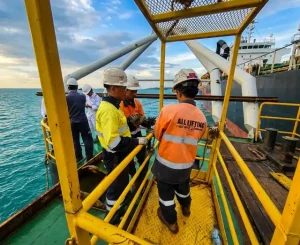 Wire rope socketing is a process of permanently securing the end of a wire rope into a metal socket using a filler material such as molten zinc (spelter) or synthetic resin. Once the filler material cures or solidifies, the wire rope becomes firmly locked inside the socket, allowing tensile loads to be transferred safely and efficiently.
Unlike mechanical termination methods such as wire rope clips, wedge sockets, or swaging, socketing is non-adjustable and permanent, but it offers significantly higher safety and strength efficiency. For this reason, wire rope socketing is highly recommended for heavy-duty applications, dynamic loads, and long-term or critical installations.
Functions and Purpose of Wire Rope Socketing
Wire rope socketing is not merely an end connector; it is a structural component that directly affects the overall performance and safety of a lifting or load-holding system.
1. Uniform Load Distribution
The socketing process allows tensile forces to be distributed evenly across all strands and individual wires. This prevents stress concentration, which can otherwise lead to premature wire failure.
2. High Strength Efficiency
Properly executed socketing can retain 95–100% of the wire rope’s Minimum Breaking Load (MBL), far exceeding the performance of conventional mechanical terminations.
3. Long-Term Safety and Reliability
Because socketing is permanent, it is highly resistant to loosening caused by vibration, cyclic loading, or temperature changes. This makes it ideal for permanent structures and critical applications.
4. Geometric Stability
Socketing keeps the wire rope aligned with the load axis, minimizing eccentric loading and secondary stresses that could compromise system integrity.
Basic Working Principle of Wire Rope Socketing
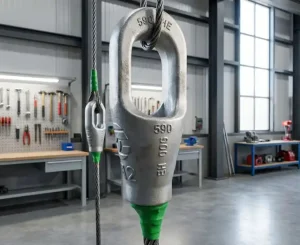 The working principle of wire rope socketing is based on a combination of mechanical locking, internal friction, and the conical shape of the socket. Most sockets are designed with a tapered internal profile that narrows toward the load direction.
During installation, the wire rope end is unlaid or “broomed” so that individual strands and wires spread apart. The filler material is then poured into the socket. Once cured, the wires are permanently embedded. Under tensile load, the wires are drawn further into the narrower section of the socket, increasing the internal gripping force.
In simple terms, the higher the applied load, the stronger the locking effect of the socketing system.
Key factors affecting socketing performance include:
- Socket taper angle
- Length and quality of brooming
- Cleanliness of the wire and socket interior
- Type and quality of filler material
Even minor errors in these factors can significantly reduce termination strength.
Types of Wire Rope Sockets
1. Open Socket
An open socket features an exposed top section, allowing visual inspection of the socketing area.
Advantages:
- Easy visual inspection
- Suitable for temporary lifting and rigging
Disadvantages:
- Lower environmental protection
2. Closed Socket
A closed socket has a sealed design with an eye or lug at the end.
Typical applications:
- Permanent structures
- Long-term load-holding systems
- Harsh environments (marine & offshore)
3. Spelter Socket
A spelter socket is designed specifically for socketing using molten zinc and is commonly used in heavy-duty applications such as large cranes, bridges, and offshore mooring systems.
Socket Body Materials
Carbon Steel
The most commonly used material, offering a balance of strength, manufacturability, and cost.
Alloy Steel
Used for very high loads and repetitive dynamic applications due to enhanced strength and fatigue resistance.
Stainless Steel
Ideal for corrosive environments such as marine and chemical industries.
Forged Steel vs Cast Steel
Forged steel sockets have a denser grain structure and superior mechanical properties compared to cast steel sockets.
Types of Socketing Filler Materials
Molten Zinc (Spelter Socketing)
Molten zinc is a traditional socketing method still referenced in many international standards. However, it requires heating to approximately 450°C, which can introduce safety risks and potential damage to the wire rope if not carefully controlled.
Advantages:
- Proven reliability
- Long service life
Disadvantages:
- Requires high-temperature heating
- Risk of wire rope overheating
Epoxy Resin Socketing
Epoxy resin is a modern and practical alternative, especially suitable for field installations. In current industry practice, many companies are transitioning to wire lock resin due to its improved safety, flexibility, and consistent performance.
Polyester Resin
A more economical option with limitations in strength and long-term durability.
Wire Rope Socketing Process
1. Wire Rope Preparation
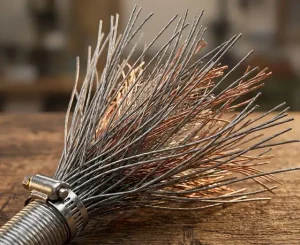 This includes cutting the wire rope to length, brooming the strands, and thoroughly cleaning all wires to remove grease, oil, and contaminants.
2. Socket Preparation
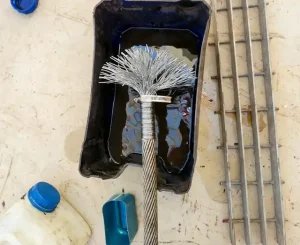 The socket must be clean, dry, and free from defects. The wire rope must be properly aligned with the socket axis to avoid eccentric loading.
3. Filler Application Using Wire Lock Resin
In wire rope socketing using wire lock resin, the resin components are mixed according to the manufacturer’s specified ratio. Accurate mixing is essential to ensure proper chemical reaction and final strength.
After brooming and positioning the wire rope correctly, the resin is slowly poured into the socket until the cavity is completely filled and free of trapped air (voids). The curing process is then allowed to proceed for the recommended duration before the socketing is put into service.
No load should be applied before full curing, as this may compromise the final strength of the socketing.
Wire Lock Resin (Resin Socketing)
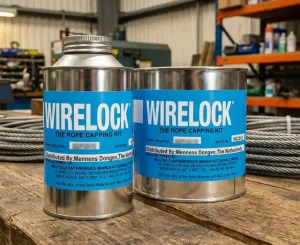 Wire lock resin is a synthetic resin-based filler material specifically developed for wire rope socketing. It is widely used in offshore, mining, heavy construction, and lifting equipment industries due to its combination of safety, strength, and ease of application.
Unlike molten zinc socketing, wire lock resin does not require heating, eliminating the risk of thermal damage to the wire rope.
Advantages of wire lock resin socketing:
- No high-temperature heating required
- Safer for technicians and work environments
- Reduces the risk of altering wire rope mechanical properties
- Easy application in workshops and on-site
- Consistent quality when procedures are followed
- Suitable for new installations and repair socketing
Wire lock resin fills the socket cavity and encapsulates the broomed wires. Once fully cured, it forms a strong and permanent bond between the wire rope and the socket.
4. Curing and Finishing
After curing, excess material is removed and a final visual inspection is conducted to ensure proper socketing quality.
Wire Rope Socketing Standards and Regulations
Commonly referenced international standards include:
- ISO 17558
- ISO 8792
- EN 13411
- API RP 9B
- ASTM standards for zinc and resin materials
These standards define socket design, installation procedures, inspection methods, and testing requirements.
Common Socketing Failures and Causes
- Improper brooming
- Air voids in filler material
- Overheating during zinc socketing
- Poor socket quality
Most failures result from procedural errors and insufficient quality control.
Inspection and Testing of Socketed Wire Ropes
Visual inspection is conducted to detect cracks, corrosion, or deformation. Proof load testing is commonly applied to verify termination integrity before service.
Industrial Applications of Wire Rope Socketing
- Crane and heavy lifting systems
- Mining operations
- Offshore and marine mooring
- Bridges and civil engineering structures
In these applications, socketing is the preferred termination method due to its superior safety performance.
Conclusion
Wire rope socketing is the most reliable termination method for heavy-duty and critical industrial applications. With high strength efficiency, long-term stability, and maximum safety, socketing has become an industry standard. Selecting the correct socket type, filler material, and installation procedure in accordance with international standards is essential for successful performance.
Wire Rope Socketing Services – PT All Lifting Indonesia
PT All Lifting Indonesia provides professional wire rope socketing servicesusing wire lock resin as a modern and safe solution for industrial applications.
Our socketing service advantages:
- High-quality wire lock resin
- No heating process (non-zinc socketing)
- Performed by experienced technicians
- Compliant with industry standards and best practices
- Suitable for crane, offshore, mining, and heavy lifting applications
With controlled procedures and a strong focus on safety and quality, PT All Lifting Indonesia is your trusted partner for wire rope socketing solutions.